PERG organizes panels on political economy at 5th CEU Graduate Conference in Social Sciences: “Old Challenges in a New Era: Development and Participation”
19-21 June, 2009
Central European University
Budapest, Hungary
www.ceu.hu/polscijournal
2009 represents a crucial year which is testing our ability to deal with substantial political and economic challenges. Bringing a continuation of the economic crisis, the deepening of the Israeli-Palestinian conflict, a new American administration, and a severe energy crisis for several of the EU members, this period is proven to be a problematic reality check for our policies and theories. Reality shows to be one more time ahead of scholars’ conceptualizations, politicians’ capabilities, and policy-makers’ solutions. With the many challenges ahead, we hope to generate interdisciplinary academic debates that tackle relevant topics in their fields of research. At the same time, we hope to connect different perspectives and approaches in order to produce high standard academic works.
We encourage graduate students and young faculty to contribute with papers and panel proposals on multiple topics. The working language of the conference is English.
Political Economy Research Group (PERG) at CEU has taken over the organization of the panels related to political economy, more specifically:
• Political economy of foreign direct investment
• Diversity between forms of capitalism in the world
• Political economy of the enlarged EU
• Political economy of development and poverty
For a list of all panels visit: www.ceu.hu/polscijournal
We particularly welcome panels proposed by scholars coming from different institutions. A panel can be proposed using the special panel form and should be accompanied by the titles and abstracts (maximum 300 words) of five papers included in the panel. Application forms can be downloaded from www.ceu.hu/polscijournal. All applications should be sent to gradconf2009@yahoo.com.
Deadlines:
- The deadline for panel proposals is April 1, 2009.
- The deadline for paper proposals is April 15, 2009.
- Accepted applicants will be notified by April 30, 2008.
- Applications after deadlines are not be considered.
The paper applications consist of:
- Completed application form (Including the abstract – max. 250 words)
- Short CV (maximum 2 pages)
- (Optional) Applicants for travel grant: Short letter for justification (up to 300 words)
The panel applications consist of:
- Completed application form
- Short CV of the panel chair (max. 2 pages). Panel chairs have the travel costs covered up to a certain amount.
Financial support:
There is no registration fee for qualified participants. Food and
accommodation are provided by the organizers. Applicants can apply for
a partial travel grant for the cheapest means of transportation. Those
intending to apply for a travel grant should write a short letter of
justification (up to 300 words).
NOTE: In case you do not receive confirmation within 72 hours please re-send your application.
For further inquiries about the conference please e-mail to: gradconf2009@yahoo.com.
For more details about PERG visit:
http://web2.ceu.hu/perg
Mar 12, 2009
5th CEU Graduate Conference in Social Sciences

Nov 5, 2008
The Current Financial Crisis: Causes, Consequences and Lessons for Theory and Policy

POLITICAL ECONOMY RESEARCH GROUP organized a round table discussion on:
THE CURRENT FINANCIAL CRISIS: CAUSES, CONSEQUENCES AND LESSONS FOR THEORY AND POLICY
Pictures and complete audio recording (also for download as mp3), and full written summary, from the event available bellow .
Event took place on Tuesday, November 4th at 5.30 p.m. at Central European University Budapest, Nador ut. 9 (MB 201)
Discussion was chaired by Julius Horvath (IRES/ECON), with following participants: Laszlo Csaba (IRES), Bob Hancke (POLSCI/IRES and LSE), Don Kalb (SOC.AN), Ugo Pagano (ECON), Gyorgy Szapary (ECON)
Audio Recordings provided by Gergo Medve-Balint:
1. Gyorgy Szapary Download mp3
2. Bob Hancke Download mp3
4. Ugo Pagano Download mp3
5. Don Kalb download mp3
6. Laszlo Csaba download mp3 A download mp3 B
Discussion:
Part 1: download mp3
Part 2: download mp3
Part 3: download mp3
Part 4: download mp3
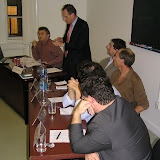 |
| Financial Crisis Panel - PERG - CEU, 4 November 2008 |
Summary: By Vera Asenova
The Current Financial Crisis: Causes, Consequences and Lessons for Theory and Policy
The good news for academics these days is that in time of financial crisis explanations for what the hell happened, are in high demand. The supply of analysis of the situation is not scarce either. Suddenly, all schools of thought celebrate the ultimate prove of their point, the crisis finally demonstrating empirically what the theory has been developing for so many years. Yet none of them is admitting defeat, and none will really disappear.
In an attempt to generate an inclusive debate across disciplines, theories and viewpoints PERG organized a public round table discussion under the title: The current financial crisis – causes, consequences and lessons for theory and policy. Our guest speakers were CEU faculty members from different departments: Laszlo Csaba (IRES), Bob Hancke (POLSCI/IRES and LSE), Don Kalb (SOC.AN), Ugo Pagano (ECON), Gyorgy Szapary (ECON), the discussion was chaired by Julius Horvath (IRES/ECON).
Prof. Szapary, who is also a vice-governor of the National Bank of Hungary, started with outlining the main reasons for the subprime crisis - excess liquidity, and low interest rates, which were kept for too long of a period in the USA, while inflation was also low; on the housing market the high loan to value ratio generated a big amount of toxic assets in the banking system, which is the second main reason for the crisis. He presented the bubble as a rise of real estate prices much higher than the rise of production costs for homes and the population growth. This bubble soon triggered panic: “social intoxication,” and confidence crisis, with banks having stopped lending to each other. The lack of regulation on investment banks and hedge funds had put them in a position of being “too big to fail”, which was not recognized by the national authorities on time. What followed were bankruptcies unseen before in the USA, UK, and Europe, which called for decisive government action. They had “nothing right on the left and nothing left on the right” to use Szapary’s words. Still, two kinds of policy actions followed – central bank injection of liquidity into the financial system, and government bailouts of banks through recapitalization of banks, purchases of toxic assets and deposit guarantees. 3000 billion USD is the total US government commitment so far. Growing fiscal deficit and government debt, followed by increase of taxes, unemployment, inflation and huge losses of wealth are the main consequences of the crisis. One of the lessons to learn is that measures for international burden sharing are needed in a globalized financial world. The countries with the majority of foreign owned banks face a problem of mother banks terminating lending to their subsidiaries abroad, thus forcing the national central banks to bail them out, or inject liquidity beyond its capacity. At the same time, an obvious conflict of interests arises for the central banks in the countries of the origin of the mother banks, who feel reluctant to export capital to foreign financial systems. Who should be the lender of last resort in a globalized financial system?
Bob Hancke spoke of the political roots of the crisis, which in his view lies in the independence of central banks. Lack of regulation, the political roots of the crisis lie in the decision taken in the nineties to deregulate the financial sector. Central Banks have failed as apolitical regulatory agencies, and many of them have in fact been captured by investment banks – serving their particular interests by keeping the interest rates too low. The rule based monetary policy worked for a short while, but soon governments had to come back into the driving seat, although formerly they were considered incapable. Today’s crisis proves this is not true; governments are the viable alternative to failing markets. What they are doing today is not so different from what they did in the thirties. After ”trying out” communism and fascism as alternatives to laissez-faire, social democracy emerged as an understanding that markets are fundamentally good, but you need to regulate them well. It is the kind of viable system where governments play a large role in the economy through central banks and fiscal policy. Hancke opened the debate on central banks and what they are really for. Currently their mandate is diffuse, focused on price stability without achieving it, while the stability of the financial system is taken out of the mandate. Thus the current crisis has shown that central banks are losing their legitimacy, as well as their independence.
Ugo Pagano’s talk entitled “The End of Anglo-American capitalism?“
Both models of capitalism are susceptible to systemic crisis – the one based on flexible financial and labor markets, and the one based on arms length relations between creditors and debtors. The weakness of the Anglo-American flexibility model have now become very clear, and they come down to diluting of agency relations, and destruction of social capital; lower total monitoring; and arising of new rigidities. This new rigidity plays itself out as an impossibility to renegotiate the debt when the price of the collateral went down – when everybody is a creditor the bargaining and renegotiating of debt becomes very difficult.
Secondly, Pagano also shares the view that bubbles are characteristic of the economy – high expectations drive prices up, this was the case of the internet bubble, oil bubble etc. each bubble has a grain of truth – a reason to believe that prices will go up (internet is a great thing; emerging industries, China and India will increase global oil demand etc.) but this grain of truth gets hugely inflated. The more financial instruments created on the basis of this inflated expectation the bigger the bubble gets.
A third phenomenon is the moral hazard problem – some actors are too big, and too interconnected to fail. The danger would have been less severe if these institutions were never allowed to become so big, or to have kept the financial sector under control.
What will happen now? America and Europe follow two different roads. America is an earlier democracy, which believed that wealth should not be concentrated in the hands of a few big families but dispersed. Still the financial sector performed a hidden redistribution function, and is currently in crisis.
Europe’s trajectory starts with first having the big families ruling through concentration of capital. On the other hand, the power of workers is concentrated in trade unions that react, and trigger change.
England started as a strong families, and strong unions capitalism, and moved to a dispersed ownership American model, and is now in crisis due to its huge financial sector and huge state intervention. But this is not the end of the Anglo-American model of capitalism.
Don Kalb – the VoC [Variety of Capitalism] schools is happy about this crisis as it puts the question of what kind of regulation are we going to have. But we need to discuss societies, because societies drive politics, which drive institutions. One thing we learn from this crisis is that institutions don’t work if they are left alone. Even if you introduce more regulation, you need societies to do politics. To analyze the real social forms beyond the Polanyian and VoC framework. Kalb proposed a society-based explanation of the crisis. The neoliberal policies dominant in the last thirty years had two crucial characteristics, which are deeply contradictory and colliding:
- Increased ‘financialization’ of social life – social relations, markets, states;
- Increased social inequality and polarization.
These coinciding developments can explain why the subprime private sector is the domain of the crisis. Regulatory interventions try to prevent, or react to the problem, but cannot succeed. The neoliberal era is an era not of deregulation but of private regulation of risk; the crisis starts form large private indebtedness in the core, which built up in the nineties, and burst out recently. Income stagnation was combined with injections of cheap liquidity (provided by China, Japan and Germany) prevented the contradiction from colliding. Growing private indebtedness, declining prices and inflexible relations have been the causes of the crisis. The possibilities of reversing this adverse combination of social polarization and ‘financialization’ of society lies in the future political decisions taken in the USA. Hopefully Obama, who gets elected today, will listen better than his predecessors.
Laszlo Csaba “The Hungarian reaction. A reaction to what?” Csaba focused on the situation in Hungary which is not facing a deep capitalist crisis like the USA but a panic on the financial market. Due to the underdevelopment of its financial system, Hungary can never commit the mistakes of the USA – the benefits of backwardness. Before discussing the Hungarian government reaction, one needs first to define a reaction what is being sought. Unlike the great depression 1929-35 an overall contraction of GDP in the American economy is not present om the real economy which is not in recession yet. Situations of panic are typical of the financial market. This market has been the source of immense wealth creation – the system which is unregulated, unjust etc. has contributed to eighty percent of the wealth in the last hundred years.
The name of the game is psychology, and the main issue here is the trust. In Hungary the government has very low credibility both because of its members, and because of its economic policy. People do not care about the government because it is politically compromised, and also because it keeps making welfare promises it does not deliver. Low level of credibility is an especially big problem in times of crisis.
Now the reaction of the government was not to listen to the warnings. The national bank, research institutions, and other organizations have been warning the government that tax and spending policy does not work in a small open economy, which has high degree of vulnerability. In this case sustaining a national currency is a luxury and it also enhances the vulnerability of the economy. Joining the currency union as soon as possible should be a priority also of the government, as well as of the median voter. When the crisis hit, the government did not believe it, and kept saying that this was an American problem, which does not affect Hungary. In addition to the liquidity crisis, there was a recent attack on the Hungarian Forint, which lead to almost 20% devaluation of the exchange rate, and from this moment the panic spread. The forecasts was a slum of - 1.5%. An emergency plan was provided by an IMF standby loan of 25 billion dollars together with the European Union, and the World Bank. The attack has now been partially reversed, and the stock exchange is recovering.
Csaba was skeptical regarding the benefits of crisis often discussed by economists – the idea that hard times provide a window of opportunity to sell the wonderful ideas of the economic science to politicians, and bring reform. The primacy of politics will close the window of opportunity and instead of long term economic growth, short term measures, and muddling through will take place for as long as possible.
What followed was an exciting discussion, which can be found on our blog. A commitment to organize another discussion on the topic later, and a few rounds of drinks at a nearby bar.
Read more on The Current Financial Crisis: Causes, Consequences and Lessons for Theory and Policy
Nov 3, 2008
George Soros' lecture at CEU
Public Lecture by George Soros, Founder of CEU and Honorary Chairman of its Board of Trustees
Comments on the Global Financial Crisis
Date: Tuesday, November 11, 2008
Time: 6:15 p.m. - 7:45 p.m.
Location: CEU Auditorium
Dear CEU Community Members
We are privileged to announce a Public Lecture by George Soros, Founder of CEU and Honorary Chairman of its Board of Trustees
Comments on the Global Financial Crisis
Chair: Lajos Bokros, COO/Professor, Department of Public Policy/
Department of Economics
Date: Tuesday, November 11, 2008
Time: 6:15 p.m. - 7:45 p.m.
Location: CEU Auditorium
George Soros is not only a legendary financier and philanthropist, but also a widely-read author. His latest book, The New Paradigm for Financial Markets: The Credit Crisis of 2008 and What It Means was released in April 2008.
The opening sentence, summarizing his sense of urgency about the turmoil in the financial world, “We are in the midst of the worst financial crisis since the 1930s.” has of course proved to be an accurate prophecy. As the subsequent global financial crisis has unfolded, he has been asked to speak and write on this topic in the leading financial and news publications and television worldwide.
As there will be an enormous amount of interest in this lecture we are restricting it to the extended CEU community for this reason. We also ask you to indicate whether you will be attending by Monday, November 10, at noon. Seats cannot be reserved, except for one group of students originally included in program, and will be on a first come-first served basis. Your response regarding your attendance will give us an indication of numbers and thus assist us in arranging additional seating, including a screening area.
Please RSVP to soroslecture@ceu.hu by November 10 at 12 noon.
For your reference we have some background reading materials before the lecture. These are available on www.ceu.hu/soroslecture
Your
Yehuda Elkana
Oct 30, 2008
3rd Energy Forum Budapest
The event opened by a presentation of The annual Energy Outlook 2008, introduced by Justine Barde, EIA Economist. Second day was opened by President Solyom, followed by 7 panels on wide-ranging topics. Out of the political speeches, Hungarian opposition leader Viktor Orban, in his address, emphasized new regional cooperation, strengthening north-south infrastructural linkages, and framing of the energy crisis as an economic opportunity. It was quite interesting hearing from him also about the geothermal and solar opportunities in Hungary, which was later on taken up by more technical presentation by MOL experts (MOL is a leader in Geothermal in Hungary). Zeyno Baran emphasized the need for clear Russian strategy, for EU and especially for CEE. Kresimir Cosic, member of the Foreign Affairs Committee of the Croatian Parliament, presented Croatian Energy strategy and plans to build LNG terminal at Krk. Interesting discussion emerged during the panel on trade-off between competition and Energy security, when Laslo Varro, vice president for strategy and development of MOL Hungary, and Said Nachet, the energy director of International Energy forum secretariat, Saudi Arabia discussed market issues of spare capacity, pricing incentives of not removing the infrastructure bottle necks, and the effects of (de)regulation and unbundling.
Although there were no surprising news, if one follows the energy landscape in Central Europe, the discussions pointed out some re-emerging topics, and highlighted issues that will be on the agenda in the upcoming months or even years. We will surely follow developments around Nabucco v. South Stream, which should be discussed early next year at the special Nabucco summit to be held in Budapest, as well as issues of Central European Energy cooperation, which does not yet have any specific contours. Read more on 3rd Energy Forum Budapest
Sep 12, 2008
The Economics of Energy Security panel
Freedom House Europe, with support from the embassies of the United States, the United Kingdom, the Czech Republic, the Netherlands, Norway, and Central European University, organized a roundtable series focusing on energy security in Europe.
PERG section editor Andrej Nosko moderated the first of the series, The Economics of Energy Security panel. The proceedings of the panel are now fully available in flash video format on the Freedom House Europe website. In addition, downloadable versions of select presentations are also available.
Video of Andrej Nosko introducing the Freedom House Panel on The Economics of Energy Security and the first speaker Professor Alan Riley from City University in London discussing the challenges posed by Russia’s inefficient gas industry to Europe’s long-term energy supplies:
More videos are available directly from the Freedom House Europe website.
May 22, 2008
Greskovits' speech at Kornai's book launch
 János Kornai „From Socialism to Capitalism. Eight Essays.” Budapest and New York: Central European University Press 2008.
Book launch speech of CEU professor Béla Greskovits on May 21, 2008
Ladies and Gentlemen, Dear Colleagues, Students, Guests and Future Readers,
János Kornai wrote a powerful, sophisticated and inspiring book again. I wholeheartedly recommend it to exacting thinkers also including non-academic professionals, such as policy makers, journalists, politicians, diplomats and other educated audiences. The volume has especially great potential to form the research agenda of new generations of social scientists. It encourages graduate students from multiple disciplines - economists and political scientist, sociologists and historians - to not shy away from asking and searching answers even to the biggest, most puzzling questions. Such questions, as once Karl Marx, Friedrich Hayek, Joseph Schumpeter, Karl Polanyi, Albert Hirschman and now János Kornai has taught us, always require intense curiosity but also the courage to „trespass” narrow disciplinary boundaries. In addition, the volume highlights for young social scientists still „in the making” some essentials concerning proper scholarly attitude and behavior.
Clarity, self-reflection and humility
This collected essay volume is an exemplary demonstration of how productive an ambitious research program can be – especially when conducted with a measure of clarity, self-reflection and humility. Such important messages are being delivered as much by the style as by the content of the volume.
a) As to clarity, Kornai is very clear whenever he comes to separating scholarly (positive) statements from normative judgements. This is what he expects from others too. Clearly, for a social scientist that is the right (but not always easy) way to go. At the same time, I truly appreciate that the author does not hide his own personal choices and preferences in cases when not all good things go hand-in-hand: He chooses being a democrat versus an advocate of rapid transformation at any cost (Essay 7), and prefers peaceful and non-violent change over revolutionary ferver and justice (Essay 6).
b) Self-reflection equals honesty and manifests itself in admitting failure or limits of knowledge. Kornai does not hide from the reader where he feels to have been wrong: e.g. in underestimating the speed and acceleration of the erosion of the socialist system (Essay 8). He also points out the questions to which he lacks answer: e.g. where are the boundaries of mainstream economics’ versus the system paradigm’s competence (Essay 8). Surely the point is not simply that honesty is a virtue that scholars must adhere to. Even more important is that self-reflection brings „dividends” for the dissemination of knowledge. Readers will easier trust an author who is sometimes wrong, sometimes has no idea of the correct answer, but admits whenever this is the case. Conversely, if a scholar claims to be right always and on everything, we might start wondering whether s/he has ever been right in anything at all.
c) Last but not least, a degree of humility is indispensable precisely because our world is complex, interdisciplinary research is a demanding enterprise, and our knowledge has its limits – more serious ones than typically admitted.
I feel the need to emphasize these merits of the volume because they are rare in the world of social research populated by too many over-size Egos. Indeed, oftentimes we meet more self-righteousness and arrogance in a single short journal article, which equals a life’s scholarly output, than in Kornai’s collected volume that summarizes only some of his path-breaking contributions. Let me now turn to some of the substantive issues elaborated in the book.
In defense of holistic social science
This would be my shortest way to interprete the general thrust of Kornai’s Eight Essays. I admit that his approach is close to my heart and has been formative of my own profile. Holism – in Kornai’s term the system paradigm - is one of the major (although nowadays not the most fashionable) traditions in social thought. At its core lies „the idea of totality, a social whole that provides the necessary context for grasping particular social dynamics” (Fred Block and Margaret R. Somers, „Beyond the Economistic Fallacy: The Holistic Social Science of Karl Polanyi,” in Theda Skocpol, ed. Vision and Method in Historical Sociology, Cambridge: Cambridge University Press 1984: 62). Kornai, who has been and will remain in future a grand-master for many of us attracted by this kind of thinking in Hungary and abroad, has built up the volume from the first essay to the last one, to introduce, present and defend the holistic approach in a number of ways and at various levels.
a) First, the system paradigm’s analytic potential is demonstrated by Kornai’s pioneering account of the classical socialist system as an ideology- and politics-driven bureaucratically coordinated socio-economic totality (Essay 1). Those who so far have not read his The Socialist System. The Political Economy of Communism (Princeton N.J.: Princeton University Press 1992) certainly should get a taste of that important work by reading this essay. At least in my view, no one else has offered a more convincing and theoretically more sophisticated account of state-socialism.
b) Second, in essays 2, 3 and 4, the system paradigm is adopted as an analysis of social dynamics. The accounts of reform-socialism (Essay 2) and of the genealogy of its very different underlying ideas (Essay 3) are there to demonstrate a key systemic propensity: until a system persists it is able to reproduce its major features. Thus socialist reforms – experiments to mix or combine bureaucratic with market coordination and public with private ownership – repatedly ran into systemic constraints, both ideological and institutional. Taken together, essays 1, 2 and 3 are also useful reminders for social scientists, journalists and politicians who by now have become nostalgic about the socialist system and tend to deemphasize its abhorrent and debilitating features. Furthermore, precisely because social systems are held together by interlocking institutions and mechanisms, they are difficult and slow to change. This is demonstrated in Essay 4 on the example of various policy efforts in the course of post-socialist transformation. Kornai warns radical reformers that being „fast” with every aspect of institutional change simultaneously is impossible and even counterproductive. Since advances in varied areas – e.g. price and trade liberalization versus property transformation - take different time to unfold, uniform haste might produce large waste.
c) The second half of the volume accomplishes three tasks. Essay 5 is an effort to build a bridge between the macro-social historical significance and achievements of Central and Eastern Europe’s Great Transformation on the one hand - and the everyday feelings, joys and anxieties of the individual on the other. Essay 6 and 7 demonstrate how the system paradigm can help comparisons of socialism and capitalism, autocracy and democracy, as well as countries in different phases of transformation. Finally, Essay 8 is devoted to a general theoretical appraisal of the system paradigm. Here Kornai also gives examples of his companions in paradigm. Among them, Marx with 16, Schumpeter 10, Hayek 8, and Polanyi 6 references appear as by far the most frequently (approvingly and critically) cited scholars in the volume.
Although it is not central to our purposes today, but this list made me curious to ask János: If the above are the main companions who are the main adversaries? Are there important thinkers - rather than merely thoughts not readily linked to specific authors - in social science whose views Kornai intensely dislikes and critically rejects?
The main task of Essay 8 is to summarize the system paradigm’s principles, puzzles and methodology, and outline tasks for future research. The latter include encouragement of further inquiry into the micro-, macro, and mega-worlds of social systems: the study of China that is becoming capitalist without being democratic; varieties of capitalism; sub-systems such as the welfare states and their interactions across different political- economic areas. Last but not least, Kornai raises the biggest question that seems the more pertinent as it appears to be entirely out of fashion in capitalism’s current hegemonic phase: If – as both logic and history tell us – there is no such thing as an ever-lasting system, then how to think in a responsible manner about capitalism’s future prospects, potential successors or alternatives? His programmatic outline takes me to the next interesting issue raised in the book.
Relationship between the „mainstream” and the system paradigm
I who felt more than convinced by János Kornai about the merit of the macro-social approach generally, and specifically by his own way of cultivating it in the book, was surprised to sense a measure of disappointment and, perhaps, even defensiveness in his tone and posture – especially when he comes to delineating the place of the system paradigm vis a vis mainstream neoclassical economics.
„It is not a scientific revolution in Kuhn’s sense that I miss. I am not calling for the mainstream paradigm to be superseded by another paradigm. All that is needed, after the great experience of the post-socialist transformation, is for mainstream normal science to recognize more clearly its limitations. It has to understand better what it is competent to do and what it is not” (p. 197).
I thought it would be very interesting for all of us to hear János’s reflection upon the following questions:
a) Why not call for more than merely a modest place under the sun - or what Kornai calls a „complementary role” on mainstream’s flanks - for the system paradigm?
b) One might or might not be convinced about the merit of a „peaceful coexistence” between alternative truths - but is this possible at all in this specific case?
I am the more curious about the answer as Kornai tells his readers:
„I may be wrong, but I have the impression there are very few people in the economic profession who accept this narrowed, more modest domain of validity for the ’mainstream paradigm’. Indeed, there are some who have drawn precisely the opposite conclusion from the change of the system in the 1990s. They mistake the victory of the actual capitalist system over the actual socialist system, for a victory of neoclassical mainstream economics over all other, alternative paradigms” (ibid.)
Let me briefly list the main features of the system paradigm as summarized by Kornai (pp. 190-3) and contrast them with their stylized alternatives (as I understand them) in mainstream economics:
a) methodological holism versus methodological individualism;
b) inter-disciplinarity versus anxiously guarded disciplinary boundaries of what Albert Hirschman earlier dubbed „mono-economics”;
c) focus on institutions and their historical paths versus individuals and (if at all) institutions without history;
d) system-shaped preferences versus given individual preferences;
e) focus on social dynamics versus on social statics;
f) concrete qualitative and quantitative comparisons versus abstract modeling.
At least in my own understanding these two paradigms appear not as complementary but rather opposite to each other in many key attributes of their profile.
Can they both be „half-way right”or wrong? Can they peacefully divide their territories by a demarcation line not passed except with good intentions?
Systems and individuals
Let me address the last important issue that the book made me think about. This is the issue of linking the life of big systems, structures, institutions and processes with the everyday life, hopes, fears and decisions of the small individual or firm. Holistic social science is often criticized for not doing a good enough job in connecting these two fundamental levels of social existence.
I believe that by focusing on the interactions between the micro behavior of firms, workers, consumers and bureaucrats on the one hand, and the systemic macro-logic on the other, the first part of the volume offers a sophisticated and rather complete picture of the intricate links between agency and structure under the socialist system in all its variants.
Yet, I also found that the second part – with the emerging capitalist democracies in its focus – should rather be read as an account of not yet completed work that urges further in-depth inquiry. In concrete, I sensed that the responses of individuals and firms to the challenges and incentives of the new system – and especially their impact and feedback on its functioning, stabilization and prospects - deserve more attention and stronger emphasis. Let me give two examples.
a) In Essay 6 Kornai tells capitalism from socialism, and democracy from autocracy, on grounds of admittedly minimal, formal and procedural criteria (pp. 125-6 and 132). But my feeling is that even the positive – rather than normative – approach should go far beyond the minimal criteria to be able to define systems. Why? By the term “system” we refer to constructs that exhibit a degree of order, stability and durability. Constructs lacking these aspects are “non-systems.” Instead, they might represent states of chaos, uncertainty and disorder. To come up with an analogy, our global climate is a system while the daily weather is not. Of course, the former – as we witness today – can change too, but its changes denote very different processes than the usual capriciousness of April weather. It follows that without having a relatively clear idea of the stability and sustainability of capitalist and democratic orders, it is ambiguous to positively define them as “systems” to begin with. How do we know that a social construct (such as democracy) that seems like a system today, will still look like one tomorrow, if we do not inquire into its degree of popular acceptance and legitimacy upon which its stability ultimately hinges? However, as Kornai himself warns: “The minimum conditions say nothing about the stability of democracy. They allow a test of whether there is democracy in a country at a particular time” (p. 134). In terms of the weather analogy this means that minimum conditions do not allow testing the shape of the “system” – the global climate that might be in deep disorder – they only allow telling something about the “event,” the daily weather. Back to the general question: How helpful are, then, minimal formal and procedural criteria in separating a system from a non-system – and, by implication, one system from another? Surely such criteria might qualify as necessary conditions of a system – but are they sufficient?
b) In Essay 5, János Kornai assesses the outcome of The Great Transformation of Central Eastern Europe in the contradictory terms of success and disappointment.
“I keep two accounts, not one, and do not merge them. On one account, I gladly acknowledge great success on the level of world history: the system created is superior to the old and has arisen without bloodshed, at incredible speed. On the other account, I have the list of good and bad experiences in everyday life: much joy and much pain. I consider it sensible and defensible to say that the events in this region can be considered simultaneously as a success in terms of global historical significance and at the same time in many important aspects a process associated with trouble and suffering because it is a cause of pain, bitterness and disappointment to so many people” (pp. 119-20).
Again, a question similar to the above can be asked. I am not sure to have fully understood the reasons for Kornai’s reluctance to - not so much drawing a balance but - elaborating on the implications of the above contradiction, since this further step would fall within the domain of competence of the system paradigm. As with my previous questions, I think it would be very interesting for all of us to hear János Kornai’s reflections.
My concern - both normative and positive with a stress on the latter - is the same as above. Clearly, the new system’s short and long-term prospects are shaped – to talk with Albert Hirschman - by elite and popular exit, voice, and loyalty, which ultimately hinge upon how these actors draw their own balance between gains and losses, the joy and pain of everyday life. If the new system is cause of pain, bitterness and disappointment on massive scale then how long is it likely to last? Will there be - say in a decade or two – still any world historical success to speak of? I share Kornai’s skepticism about predicting the future. I would rather wish to emphasize a more modest ambition: Simply put, further work awaits us to try and link structure with agency, macro-social systemic processes with human micro-behavior, gains and losses, fears and hopes.
Dear János, congratulations to the new book, and thank you for your guidance and inspiration.
Read more on Greskovits' speech at Kornai's book launchMay 9, 2008
Join us at the CEU graduate conference
Join us at 4th CEU Graduate Conference in Social Sciences on Global Transformations: Integration, Transition and Development June 20-22, 2008 - CEU, Budapest, Hungary PERG will organize two panels: 1. Political economy of foreign direct investment 2. Diversities of Central and Eastern European Capitalism Application are closed, but if you are around in Budapest
you are welcome to join our panel